Requirements Traceability Matrix (RTM) in regulated industries
How connected traceability reduces the cost of audits, client reviews, and regulated releases.

Nitin Deshmukh

A team can run a disciplined testing process, catch real bugs, and ship on schedule, and still spend real time before an audit rebuilding proof that any of it happened. The tests happened. The approvals happened. The problem is that the record of what happened is split across a requirements tracker, a test suite, a CI pipeline, a defect tracker, and whatever tool held the approval, and nobody keeps a running answer to whether all of that connects, only the individual pieces.
That gap costs more than audit week. It shows up in how long a client security questionnaire takes to answer, how confident a release manager feels signing off on a regulated release, how often QA, engineering, compliance, and security end up in the same thread re-deriving something one of them already knew, and how much time gets spent rebuilding evidence that technically already existed, just not anywhere anyone could point to.
Visibility you can use between audits
Most of what gets called "audit prep" is really a visibility problem that's been sitting untouched since the last release. A coverage gap found on an ordinary Tuesday is something a team can prioritize on its own schedule. The same gap, found because a reviewer asked for it, is now something to explain under a deadline, to someone who wasn't around when the decision not to test it got made.
Connected traceability is useful long before anyone asks for it. It gives a team a way to check its own position at any point, including the ordinary weeks between scheduled reviews.
What DORA, SOC 2, and client reviews expect
These frameworks name no specific tool, and they don't expect the same artifact from every team. They share one expectation: a team can demonstrate, on request, that changes were tested, approved, and controlled.
DORA, the EU's Digital Operational Resilience Act, requires financial entities to maintain a controlled, risk-based approach to ICT testing and change management. Certain financial entities identified by competent authorities must conduct threat-led penetration testing at least every three years, although the frequency may be adjusted based on risk and operational circumstances. Underneath that, DORA's change-management expectations are functional rather than tool-specific: the function approving a change should be independent from the functions requesting or implementing it, and the change itself should go through testing appropriate to its risk before it's trusted. None of this requires a named traceability matrix. What DORA requires is a controlled, documented process for assessing, testing, approving, and implementing ICT changes, with the level of control informed by risk.
SOC 2 examines whether an organization has designed and operated appropriate controls. Organizations commonly need controls showing that relevant system changes are authorized, developed or configured appropriately, tested, approved, documented, and implemented through a controlled process. An auditor may select a sample of changes from the review period and inspect evidence such as the originating ticket, approval history, test records, and deployment or implementation records. How much a gap matters depends on its nature and significance. A missing link may generate follow-up questions or an expanded sample; a more significant control failure may become an exception or finding.
Client audits and vendor-risk reviews often ask a version of the same question, usually without citing a regulation at all. A customer's security or procurement team sends a questionnaire before renewal, and an auditor or client reviewer may ask you to show which test verified a given requirement, or what failed and how the issue was handled. All three processes expect a team to answer quickly and to defend that answer if someone looks closer, whatever tool produced it.
Why reconstructing the record is the expensive part
The evidence these reviews ask for usually already exists somewhere: in a requirements tracker, a test suite, a CI pipeline, a defect tracker, and whichever tool holds the approval. The work usually did happen. What's missing is the connection between those systems, made while the work was happening, so someone ends up reconstructing that connection after the fact, under a deadline, for a reviewer who won't accept "we're fairly sure this got tested."
A matrix generated from connected systems reduces how much of that relationship has to be reconstructed manually. A record that lives in a spreadsheet, assembled the week before a review, means tracing which test covered which requirement, when it last ran, and whether the defect it found actually got resolved, while compliance, security, or a customer's reviewer waits on the other end.
What a useful record actually needs
A traceability record that only shows a link between a requirement and a test case answers less than it looks like. It needs to also carry the latest result for that test, so a reviewer can tell the difference between "linked" and "passed last time it ran." It needs any defects tied to a failure, so a failed result doesn't just sit there unexplained. And it needs some signal that the requirement itself hasn't quietly moved since the test was last run, because a passing test against an old version of a requirement is not the same thing as coverage.
How Qase's Requirement Traceability Matrix supports this
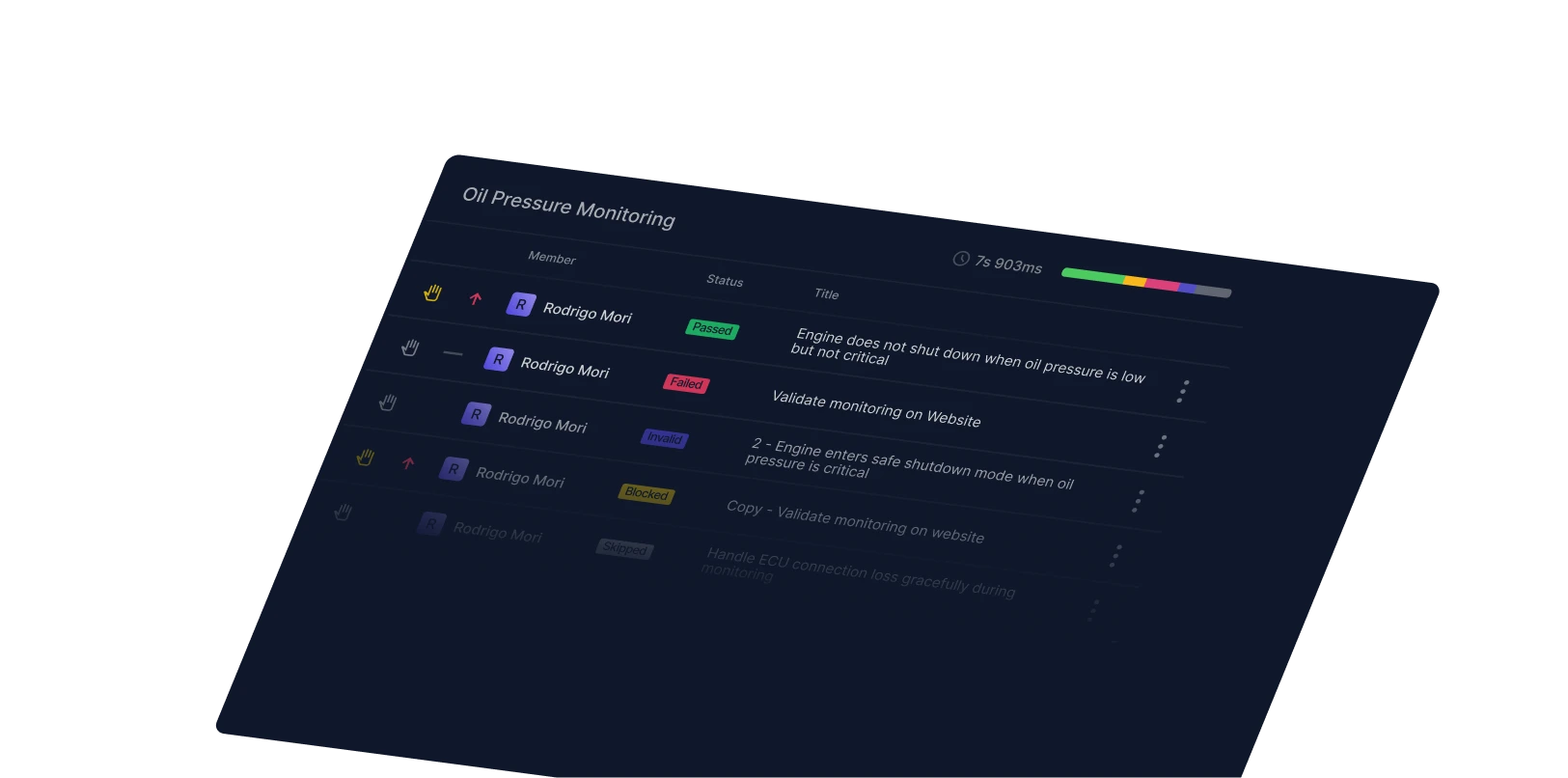
Qase's Requirement Traceability Matrix reads requirements from Jira, GitHub, GitLab, Notion, or Confluence. For each requirement, it brings together the linked test cases, their testing status, and any associated defects, and a separate view lists requirements that don't yet have linked test coverage, so a gap is something you can see and act on rather than something you find out about later.
Each requirement also shows its source status and its latest-update timestamp as of when the report was generated, alongside its linked testing information. If a requirement was updated after its linked test case last ran, the matrix flags the result as potentially stale, giving the team a clear signal to rerun the case or determine that no testing change is needed. Deciding what to do about it stays a human call; the matrix surfaces the evidence a team needs to assess whether a changed requirement still has appropriate test coverage. It does not automatically decide whether tests need to be revised or rerun.
Teams can generate successive versions of the report over time, creating a set of traceability snapshots rather than a single view that's only ever current. How long that historical evidence stays available depends on your plan and configured retention period.
Teams that need evidence beyond the matrix can use Qase's API and integrations as part of a broader reporting workflow. The exact implementation depends on the systems involved and may require additional configuration.
The Part 11 boundary
Qase helps customers produce and organize audit evidence. It does not, by itself, make a customer's configured implementation validated or compliant under FDA 21 CFR Part 11.
Part 11 governs electronic records and electronic signatures under FDA predicate rules. Whether a specific implementation satisfies it is something the regulated organization has to determine for itself, based on how the system is configured and used for its intended purpose. A vendor can support that work: documentation, qualification materials, evidence that holds up under review. No vendor can unilaterally declare a customer's specific implementation validated. That determination belongs to the customer.
If your team determines that Qase supports records or activities subject to applicable FDA predicate rules, its traceability records may support your validation work. They do not replace your risk assessment, control design, documentation, approvals, or validation responsibilities.
A note on timing: regulatory frameworks and how they're enforced change. This reflects our understanding as of publication. Check with your own compliance or legal counsel for what currently applies to your business.
What this is actually worth
The payoff shows up between audits, in the time your team spends re-deriving evidence that technically already existed: QA pulling test results, engineering explaining a defect, compliance chasing an approval, product confirming what a requirement actually said. Connected traceability doesn't eliminate that work, but it turns a multi-day manual reconstruction into something closer to a lookup, and it means the next audit, questionnaire, or release sign-off starts from a record instead of a scramble.
If you're heading into a DORA review, a SOC 2 examination, or a client security questionnaire, the best way to find out whether this fits is to connect your own tracker and look at your own gaps, not a demo account's.