Why requirements traceability matters
Coverage tells you what was tested. Traceability tells you which requirement a failure puts into question.

Nitin Deshmukh

A test breaks in CI. The name is something like test_checkout_promo_stacking . Nobody currently on the team wrote it. git blame says two years ago, and the commit message just says "add test." Is it safe to skip and merge anyway? Nobody actually knows, because nothing tells you which requirement that test exists to protect, or whether the person who wrote it even remembers.
It's easy for this to happen as suites outlive the people and decisions that created them. Take any suite that's survived a couple of reorgs, a rewrite, and a "let's clean up flaky tests" sprint, and teams are sitting on tests they can't confidently connect back to anything a product person or a customer ever asked for.
Requirements traceability is what keeps that connection alive. One useful way to evaluate it is as a six-part chain: does a test exist, is it linked, what was its latest result, are relevant defects linked, has the requirement changed, and was the test coverage reviewed after that change. Skip one link in that chain and what you get back is a guess wearing a green checkmark.
Two directions, two different questions
Many teams think of traceability as one thing: a matrix that shows which requirements have tests. That's the first two rungs of the chain, existence and linking: does this requirement have a test at all, and is that test actually connected to it. Say 94 requirements, 90 linked, 4 with no test at all.
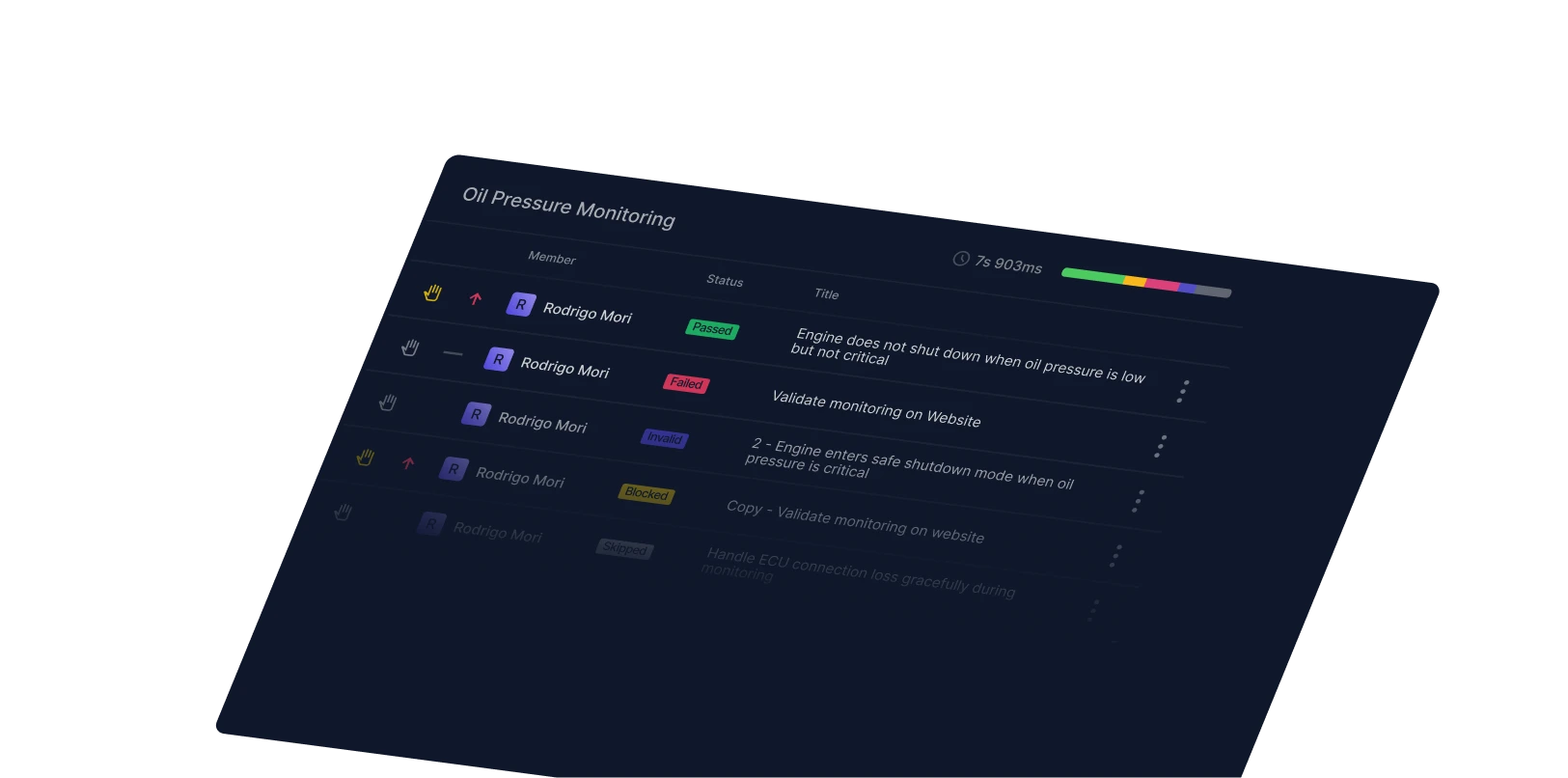
But existing and linked aren't the same as passed, which is the third rung and the one that's easy to skip. A test can be linked to a requirement and still be red, skipped, or blocked, and "linked" alone will happily report that as covered. Rung three is really "what happened the last time those tests ran": passed, failed, and blocked are three separate answers, each one meaning something different for what evidence you currently have that the requirement behaves as expected. This is the view you actually want before using the test evidence as part of a release decision: what's linked, and what its last result actually was.
Rung four asks the same kind of question from the other direction. A release isn't the only moment this matters: something breaks in production, or a defect gets filed, and the question flips from "is this covered" to "what does this put at risk." A customer reports a bug in the refund flow, and someone finally tracks it to a defect. The room needs to know which requirement that defect just broke. If nothing connects the two, that can lead to ticket archaeology before anyone can start fixing it.
What changes when the requirement does
Looking from the requirement forward, rungs one through three, tells you what verifies it and what happened when it ran. Looking back from a failed test or defect, rung four, tells you which requirement may now be at risk. Both matter, and it is easy to stop there, because those are the four questions that show up on a normal dashboard.
The last two rungs are the ones that quietly decide whether the first four were ever telling the truth. A requirement can have linked, passing tests and no linked defects today, while the evidence is still out of date if the requirement has changed since anyone reviewed the coverage. Rung six asks whether anyone did anything about it once it did.
None of this is a new idea to anyone who's had to build software under a real audit. DORA requires financial institutions to manage ICT changes through controlled processes in which changes are recorded, assessed, tested, approved, implemented, and verified. Its supporting rules also require separation between the people approving a change and those requesting or implementing it. SOC 2 examinations commonly evaluate whether organizations have controls for authorizing, testing, approving, and documenting changes before they reach production. Medical-device software standards such as IEC 62304 place much stricter controls around requirements, verification, traceability, and software changes. When a change affects previously verified software, teams need to assess which verification work may need to be repeated. The reason is simple: once a controlled artifact changes, teams need to determine whether the evidence supporting it is still valid.
You don't need to be building a pacemaker to feel that same gap. A product manager tweaks the acceptance criteria on a ticket two sprints after the tests for it were written and marked done. Nobody circles back to check whether the tests still match the new wording, because nothing prompted anyone to look. The tests stay green. The requirement, quietly, isn't what they're verifying anymore.
Why the usual answers break
Many teams already have some version of the first four rungs. It's just usually a spreadsheet, or a text field with a pasted issue ID, and both fail in the same way: quietly, and specifically at the rungs that matter most.
A spreadsheet is a snapshot. It's accurate the day someone builds it, and every day after that it drifts a little further from what's actually true, because nothing tells the spreadsheet when a requirement changes, a test gets deleted, or a ticket moves to a different epic. That's rung five failing silently: the requirement moved, and nothing in the spreadsheet knew to ask whether rung six had happened. A stale matrix can be more dangerous than an obviously missing one. It looks complete and answers the audit question with confidence, even when the answer is no longer true. And nobody finds out until the moment it matters.
Pasted issue IDs fail the same way for a smaller reason: a string like "see REQ-142" is just a note to self. Nothing updates it when REQ-142 gets renamed, merged into another ticket, or closed. The reference just sits there, correct-looking, until someone clicks it and finds nothing on the other end.
Both failures share the same root cause: the traceability record lives outside the systems where requirements and tests actually change, so it never hears about the change, which means it can never prompt rung six either. A real fix has to do one thing a spreadsheet or a pasted ID can't. A better system needs to surface when the underlying requirement changed, so the team can tell when the coverage may need another look.
What good looks like, whatever your process is
The six rungs don't change depending on how your team works. What changes is how often you have to climb them, and how much proof you need once you're at the top.
A team running two-week sprints mostly needs the full climb at the end of each sprint and again before release: what's linked, what passed, what's still open, and whether anything changed underneath it since last time. The traceability has to update itself as stories move across the board. In practice, a document that only stays accurate if someone remembers to touch it every sprint tends to fall behind.
A kanban team doesn't get that natural checkpoint. Work moves continuously, so the climb has to happen continuously too, not get reconciled in a batch. In practice, teams may make linked, passing test coverage part of their definition of done for work that requires verification, and treat a changed requirement as an automatic reopen.
A regulated release train needs all six rungs, all the time, and needs to be able to prove it to someone outside the team. The chain runs deeper: hazard to requirement to design to code to test evidence, and every link, including whether anything moved after the fact, has to survive being pulled on by an auditor who wasn't in the room when any of it was built. That's a different level of rigor, but it's the same six questions, just under more scrutiny.
How Qase does this
Qase's Requirements Traceability Matrix works with requirements from Jira, GitHub, GitLab, Notion, or Confluence, so teams can keep managing requirements in the tracker they already use. For each requirement, it shows linked test cases and their latest status right in the matrix, plus any associated defects. Click into a test to see its full run history when you need to go deeper.
Each requirement shows its source status and latest-update timestamp as of the moment the report was generated, alongside its linked testing information. Deciding whether a change requires new or updated tests remains a human call. Qase surfaces the information teams need to make that call.
Teams can generate new versions of the report over time, preserving previous snapshots rather than replacing the only view.
Separately, Qase's AI-assisted test design can draft test cases straight from a requirement. Because each case is generated from that requirement, it's linked back to it automatically, no manual step required, so traceability comes built in by default. Generated cases can be staged for review before they're saved, and once saved, they appear in the matrix like any other linked case.
None of that changes whether your team runs sprints, kanban, or a formal release process. The report brings the relevant requirements, test evidence, and defects together without forcing the team to maintain a separate traceability document.